Ingredients and steps on one page. Print it, or choose “Save as PDF” in the print dialog.
Sekai Gohan
Tres Leches Cake: Colombian Three-Milk Sponge with Meringue
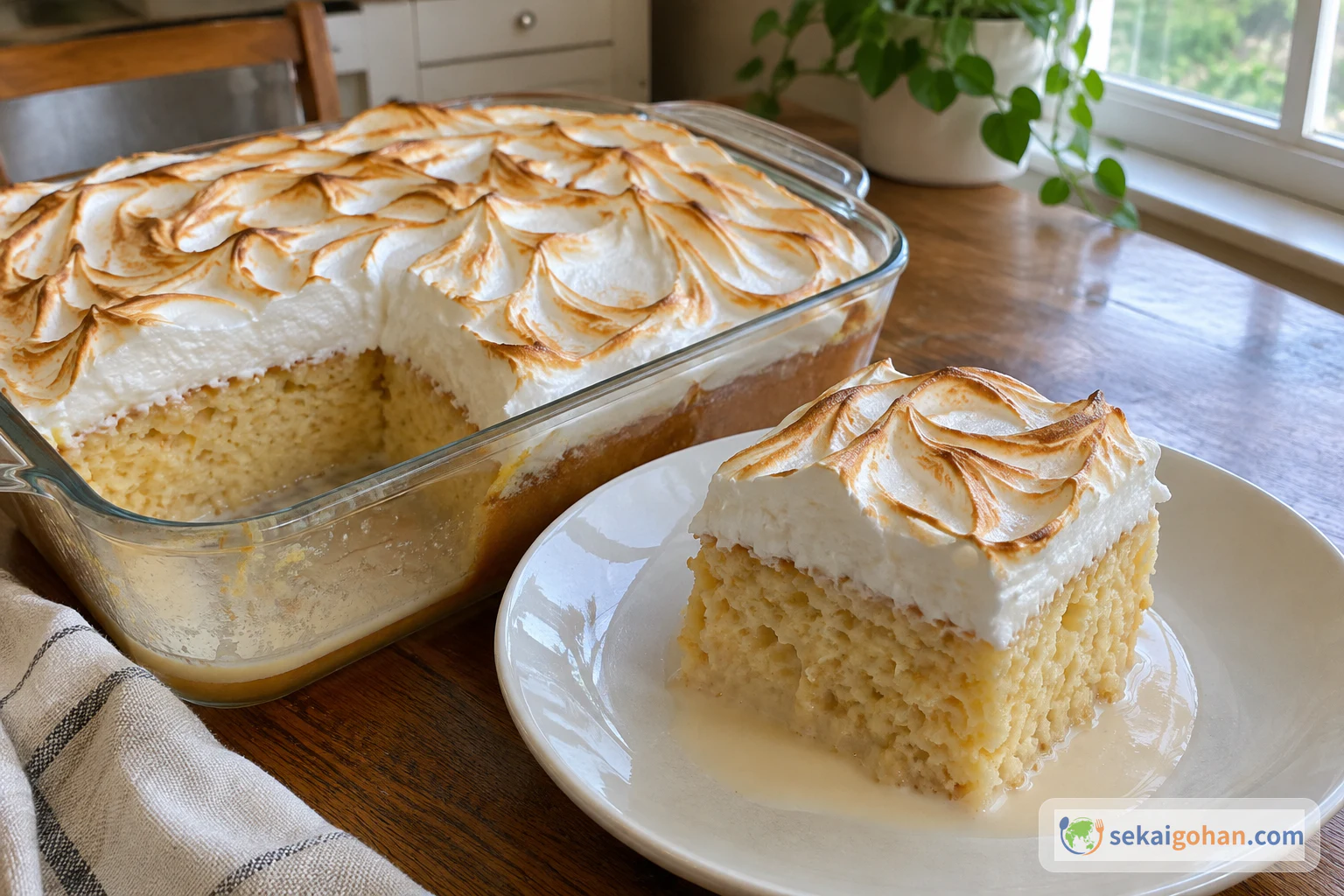
Ingredients
Sponge
| Ingredient | Amount | Role |
|---|---|---|
| All-purpose flour | 2 cups (480 ml) | Structure of the sponge |
| Baking powder | 2 tsp | Lift |
| Salt | ½ tsp | Sharpens the sweetness |
| Eggs | 5 | The beaten foam that becomes an open crumb |
| Sugar | 2 cups (480 ml) | Sweetness and a steady foam |
| Whole milk | 1 cup (240 ml) | Moisture in the batter |
| Butter | 6 tbsp | Richness |
| Vanilla extract | 1 tsp | Aroma |
Three-milk soak
| Ingredient | Amount | Role |
|---|---|---|
| Sweetened condensed milk (leche condensada) | 1 can | Sweetness and body |
| Evaporated milk | 1 can | Milky depth without extra sugar |
| Heavy cream | 1 cup (240 ml) | Fat and a rounder finish |
| Vanilla extract | ½ tsp | Aroma |
Meringue
| Ingredient | Amount | Role |
|---|---|---|
| Egg whites | 2 | The meringue itself |
| Cream of tartar | ½ tsp | Steadies the whipped whites |
| Sugar | ½ cup (120 ml) | Syrup for a glossy, firm meringue |
| Water | ¼ cup (60 ml) | Dissolves the sugar into syrup |
| Vanilla extract | ½ tsp | Aroma |
Steps
1Prepare the dish and the dry mix
Heat the oven to 350°F (177°C). Rub the inside of the baking dish with butter or oil, dust it lightly with flour, and tilt and tap the dish until the bottom and sides are coated. Knock out the loose flour. In a bowl, whisk the flour, baking powder and salt together until the mix looks even, with no streaks or lumps.
2Warm the milk and butter
Pour the whole milk into a small saucepan, add the butter and set it over gentle heat. Stir now and then as the butter softens and melts into the milk. Take the pan off the heat and set it aside while you beat the eggs. It is ready when no solid butter is left and the milk is warm but has not boiled.
3Beat the eggs, then the sugar
Crack the eggs into the mixer bowl and beat on high speed for 2 minutes. Add the sugar and keep beating on high for 5 more minutes. The mixture grows in volume and turns pale and thick. Stop when you can lift the whisk and the foam falls back in a slow ribbon that sits on the surface for a moment.
The beating is the cakeThose full 7 minutes on high give the sponge its open crumb, and that open crumb is what drinks up the three milks later. Cut the time short and you get a tighter cake that leaves milk sitting on top.
4Bring the batter together on low
Turn the mixer down to low. Add the flour mixture, the warm milk and butter, and the vanilla, and mix for 1 minute. Scrape the sides and bottom of the bowl once with a spatula so nothing hides there. Stop when the batter is smooth and pale with no dry streaks, and mix no further.
5Bake the sponge
Pour the batter into the prepared dish and nudge it into the corners with the spatula. Bake for 40–45 minutes. Push a toothpick into the centre of the cake. It is done when the top is golden and the toothpick comes out clean, with no wet batter on it.
6Poke it while it is hot
As soon as the dish comes out of the oven, prick the whole surface with a fork, right out to the edges and into the corners. Work in close rows so no patch is left solid. Leave the cake to cool for 10–15 minutes. Move on when there are holes over every part of the top and the strongest steam has faded.
7Mix the three milks
Empty the condensed milk and the evaporated milk into a pitcher. Add the heavy cream and the vanilla. Whisk until the mixture is an even ivory colour and the thick condensed milk no longer sits in a layer at the bottom. Scrape the cans so none of it is left behind.
8Soak the cake and chill it
Pour a little of the milk mixture over the cake, moving across the whole surface, and wait for it to sink in. Keep pouring in small amounts. Milk will pool along the edges of the dish, so give it time to soak in before you add more. When all of the milk has been absorbed, move the cake to the refrigerator for at least 3 hours, or overnight. It is ready to top when it is cold all the way through and no liquid stands on the surface.
Patience with the pourThe cake takes in all of the milk, but only when you pour it slowly. Tipping it all on at once floods the top and leaves a puddle that never soaks in. The result is a wet top over a drier middle.
9Cook the syrup
Once the cake is chilled, put the sugar and water for the meringue in a small saucepan. Set it over medium-high heat and stir for about 5 minutes. Take it off the heat and set it beside the mixer. The syrup is ready when the sugar has fully dissolved.
10Whip the meringue
Put the egg whites and cream of tartar in a perfectly clean, grease-free bowl. Beat them until peaks stand up. With the mixer running, pour the syrup in a thin stream down the side of the bowl and keep beating for about 5 minutes. Add the vanilla and beat 1 more minute. It is done when the meringue is glossy and white and holds stiff peaks.
Raw-egg safetyPouring hot syrup into the whites does not reliably heat them to 165°F (74°C), which is the heat that kills salmonella. Use fresh eggs that have been kept refrigerated. Separate them just before you use them, never in advance. Wash your hands, bowls and whisk well. Serve the cake soon after topping it. For older people, young children, pregnant people or anyone with weakened immunity, make the meringue with pasteurized liquid egg whites, or leave it off and top the cake with whipped cream.
11Spread the meringue and brown it
Turn on the broiler. Take the cold cake from the refrigerator and spread the meringue over it with a spatula, pulling it up into peaks and swirls. Slide the dish under the broiler for about 2 minutes and stay at the oven door the whole time, because meringue burns fast. Pull it out when the tips are lightly golden and the hollows are still white.