Ingredients and steps on one page. Print it, or choose “Save as PDF” in the print dialog.
Sekai Gohan
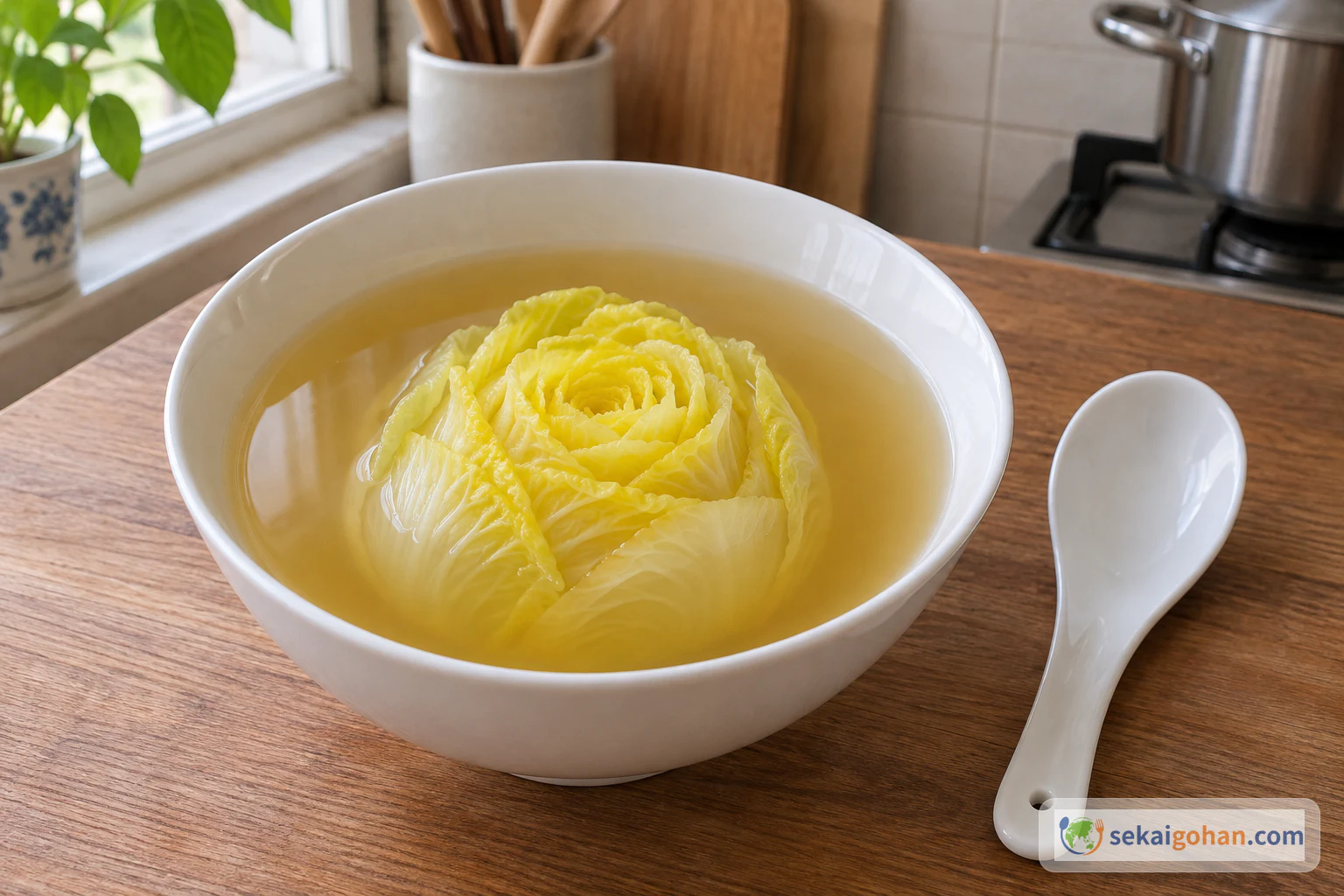
Kaishui Baicai: Sichuan Napa Cabbage Heart in Clear Broth
Ingredients
| Ingredient | Amount | Role |
|---|---|---|
| Stewing hen, or bone-in chicken legs and wings (老母鸡) | about 14 oz (400 g) | Main savoriness of the stock |
| Duck, bone-in pieces (老鸭) | about 12 oz (350 g) | Depth |
| Pork spare ribs (猪排骨) | about 11 oz (300 g) | Body from the bones |
| Ham bone, ideally from Jinhua ham (火腿棒骨) | about 6 oz (160 g) | Salt and aroma |
| Ginger (生姜) | a scant ¼ oz (5 g) | Clears gamey smells |
| Thick green onion (大葱) | about ⅓ oz (10 g) | Clears gamey smells |
| Chinese cooking wine (料酒) | about ⅓ oz (10 g) | Clears gamey smells |
| Water for simmering | about 6½ lb (3 kg) | The stock |
| Lean pork (猪净瘦肉) | 3½ oz (100 g) | Red paste for the sweep |
| Skinless chicken breast (鸡脯肉) | 2½ oz (70 g) | White paste for the sweep |
| Water to loosen the pastes | 4½ oz (130 g) for each paste | Thins each paste so it disperses |
| Salt | about ⅓ oz (10 g) | Seasons the broth |
| Ground pepper (胡椒粉) | a scant 1/16 oz (1.6 g) | Warmth in the background |
| Napa cabbage hearts (白菜心) | 4 small | The center of the bowl |
Steps
1Blanch and rinse the meats and bones
Put the chicken, duck, pork ribs and ham bone in a pot of water and bring it to a boil. Grey scum rises and gathers on the surface. Drain everything into a colander and rinse each piece under running water until the scum is gone. The bones and meat should look clean, with no grey film left in the crevices.
2Simmer the stock for 4–5 hours
Put the rinsed meats and bones in a clean stockpot with about 6½ lb (3 kg) water, the ginger, green onion and cooking wine. Bring it to a boil over high heat and skim off all the foam. Turn the heat down until the surface only trembles and simmer for 4–5 hours. With this little water, evaporation shows quickly, so check the level and keep the heat at that bare tremble. By the end the stock should look pale golden.
3Strain the stock
Line the fine-mesh sieve with cheesecloth and set it over a clean wide pot. Ladle or pour the stock through slowly, leaving the meats and bones behind in the sieve. Do not press the solids, so that the stock stays clear. You should have a golden stock with no floating bits.
4Pound the red and white pastes
Pound the lean pork into a very fine paste with the cleaver, then do the same with the chicken breast in a separate bowl. Loosen each paste with 4½ oz (130 g) water. The pork becomes the red paste and the chicken the white paste. Each should be a smooth, thin batter with no lumps of meat left.
5Sweep the broth with the red paste
Season the strained stock with the salt and pepper and bring it up over low heat. Shift the pot halfway off the burner so that only one side bubbles. Stir the red paste and pour it into the bubbling side. It sets into a clump that gathers the cloudiness. Lift it out with the fine skimmer, impurities and all, and the broth underneath looks clearer.
Let one side bubbleThe bubbling half of the pot pushes the paste around the broth, and the calm half lets impurities settle onto it. Keep the pot half off the heat for both sweeps and give each paste a few minutes to set before you lift it.
6Sweep with the white paste and finish clear
Sweep the broth with the white paste the same way and lift out the set clump. Press that white paste into a flat cake, wrap it in fine cloth and return the parcel to the broth. Keep the broth at 158–176°F (70–80°C) over the lowest flame until it is clear. It is finished when it looks almost transparent and pale gold, with no oil on the surface.
Hold the heat below a simmerClearing happens at 158–176°F (70–80°C). If the broth boils with the parcel in it, it clouds again. Check the thermometer often and nudge the flame down rather than up.
7Blanch and cool the cabbage hearts
Bring a pot of water to a boil and blanch the cabbage hearts for about 30 seconds to a minute, until they are about 70 percent cooked. Lift them into a bowl of cold water to cool. Discard the blanching water. The leaves should be just limp and still pale, with the base still firm.
8Prick the hearts all over
Drain each heart and pat off the water. Prick it all over, again and again, with a fine needle. Work gently so the leaves stay attached to the base. You should see tiny holes across the pale leaves, and the heart should keep its shape.
Needle and hot brothUse a fine needle or thin skewer that is clean and kept only for food. A sewing needle should not touch the cabbage. In the next steps, ladle the hot broth slowly and keep your hand clear of the steam.
9Cook the hearts with hot broth
Bring the clear broth up until it steams, and set each cabbage heart in a serving bowl. Ladle hot broth over the heart, pour it off, and repeat, keeping the broth hot between pours. Discard the broth you have poured off. Stop when the heart is tender all the way to the base.
10Fill the bowls with fresh broth and serve
Ladle fresh, hot clear broth into each bowl around the cabbage heart. Taste the broth and add a little salt only if it needs it. Serve at once, while the bowls are still steaming. You should be able to see the bottom of the bowl through the broth.