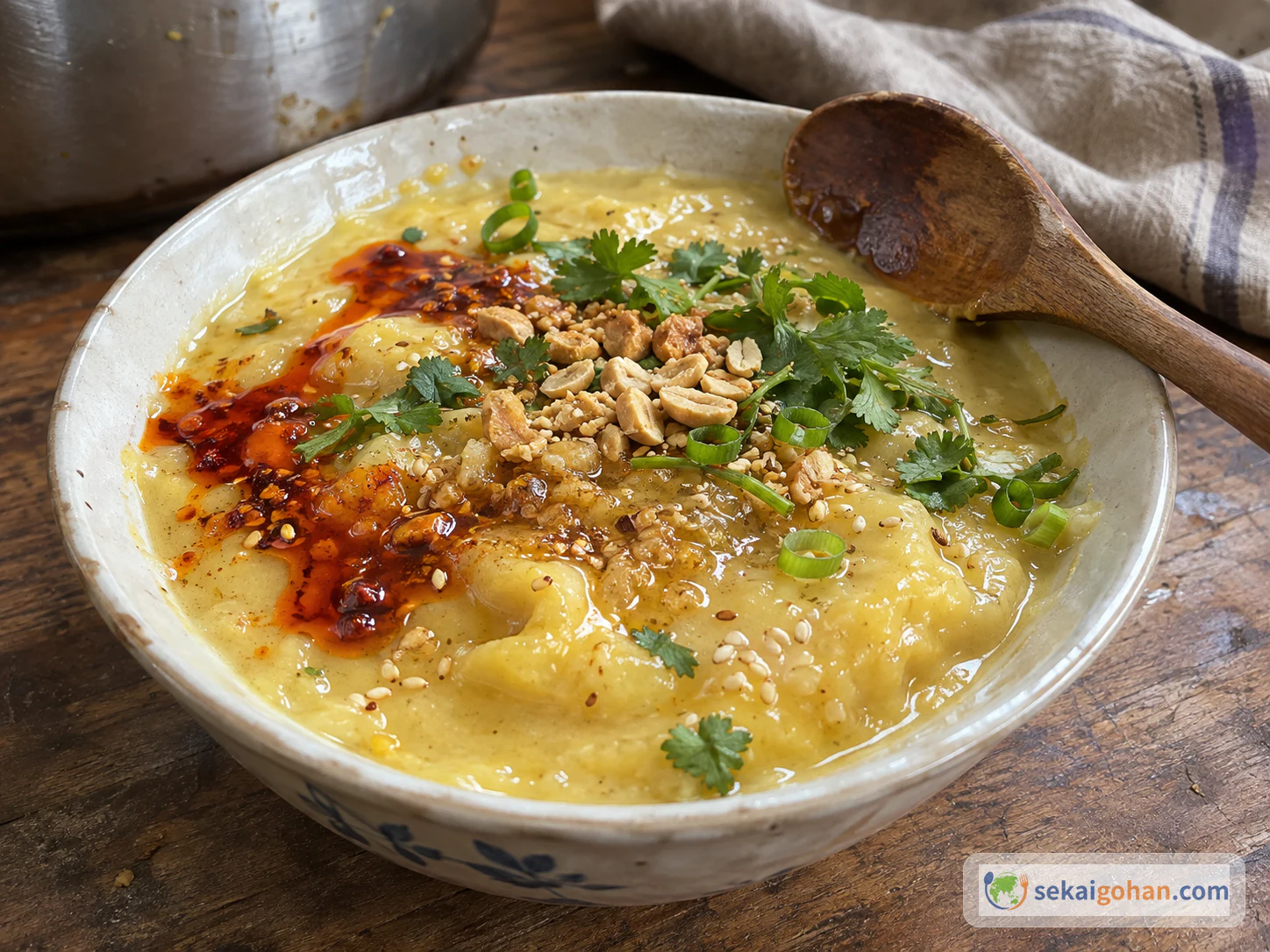
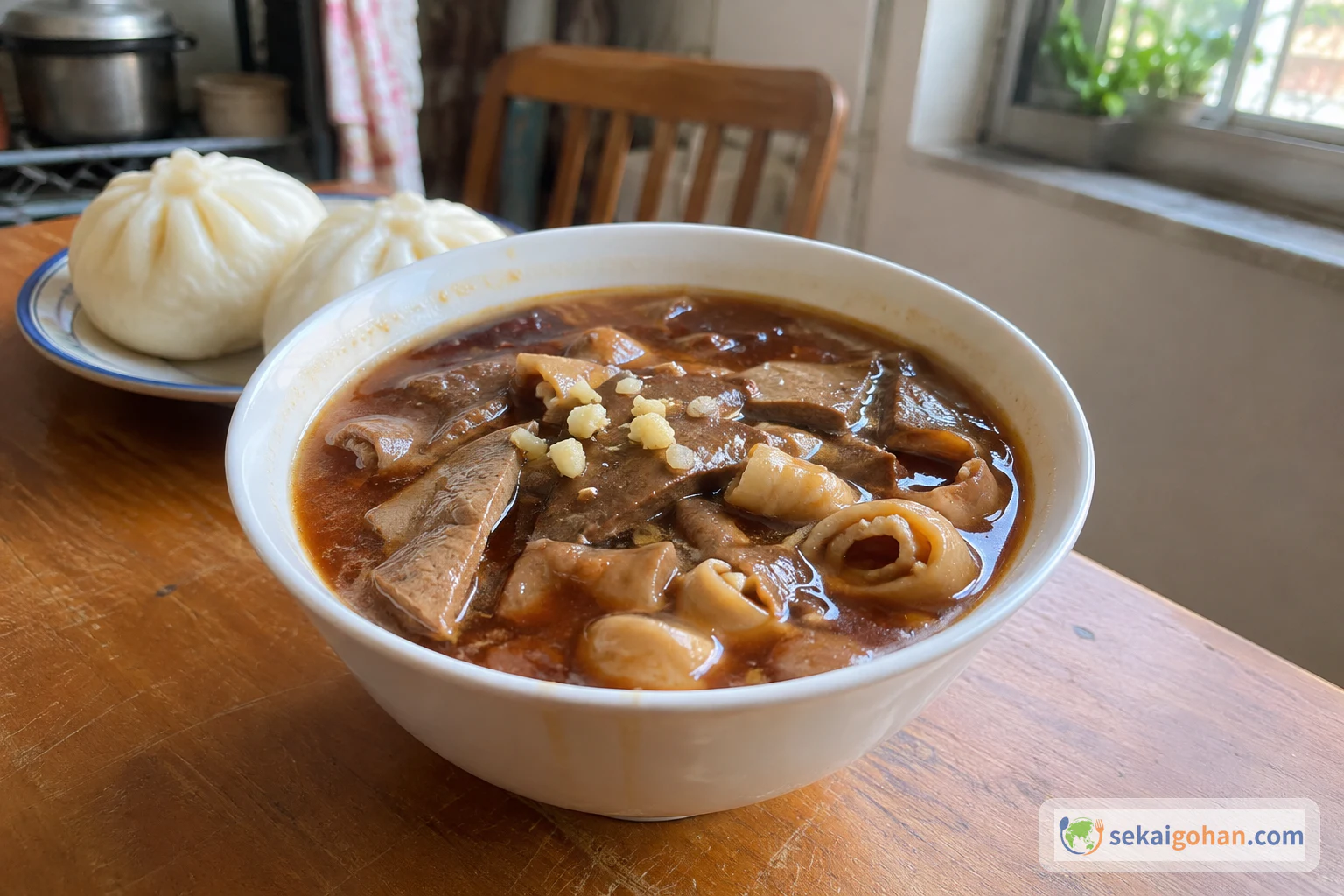
You pick the bowl up in one hand, set your lips on the rim and turn the bowl slowly as you sip. The broth is too thick to run, so it slides toward you in a glossy, dark brown wave. Short pieces of pork intestine and soft diamonds of liver come with it, and the smell of garlic is strong. This is chaogan, a morning bowl from old Beijing. It tastes of soy sauce and fermented bean paste with a deep mushroom broth underneath, and a hit of raw garlic cuts through all that richness.
A Beijing Breakfast Named for a Technique It Never Uses
The name means "stir-fried liver," but nothing in the pot is ever stir-fried. Chaogan is a simmered, starch-thickened stew, and the intestine is the main ingredient. The liver is there for aroma and body, in a smaller amount. In Beijing, the bowl holds pork liver with large intestine, and sometimes small intestine as well. Strong garlic and a soy-based savoriness are what people expect when they order it.
Where the bowl began
Where chaogan began is not settled. One story tells of three brothers whose shop sold plain-boiled pork offal that hardly anyone bought. A newspaper reporter advised them to take out the lung and heart, thicken the broth, add soy sauce and give the dish a new name. They called it chaogan, and it sold. Another story credits Huixianju, a Beijing shop of the late Qing dynasty. Huixianju is also linked to a version left unthickened, so the two stories do not line up neatly.
Locals call it liù wǎn biānr, "strolling the bowl's rim." Chaogan is too thick to stir with a spoon, and stirring turns it watery. Instead you hold the bowl and sip around the rim, turning the bowl as you go. Chaogan was once eaten with small steamed buns. Today there is no fixed way to pair it.
Its place among China's offal dishes
Beijing has other pork intestine dishes, such as luzhu huoshao, a separate dish. Chaogan is easy to tell apart by its texture. It is a thick, spoonless bowl meant for the morning, and its garlic comes twice, once cooked into the base and once raw at the end. For more of the country's cooking, see our China page.
Ingredients
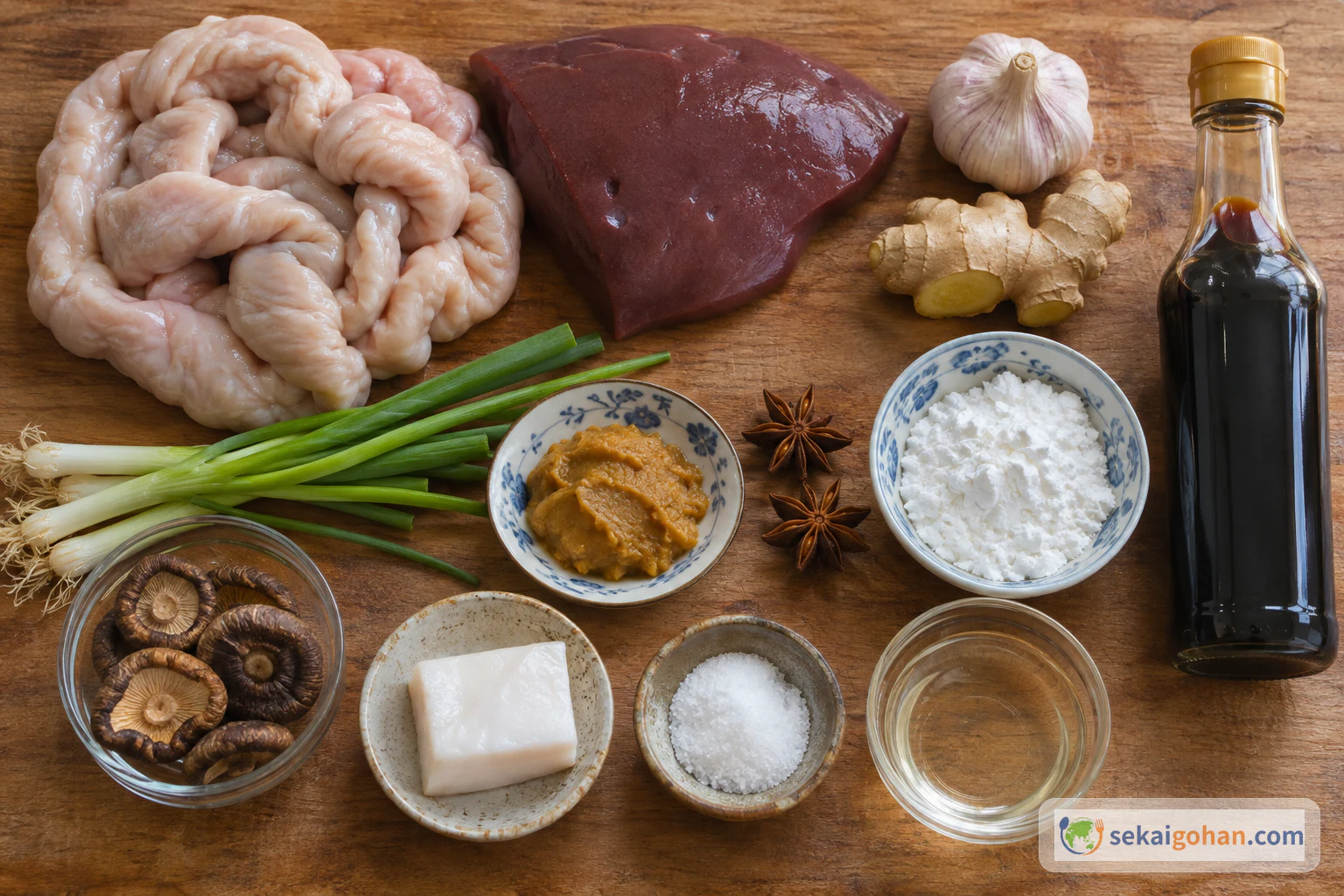
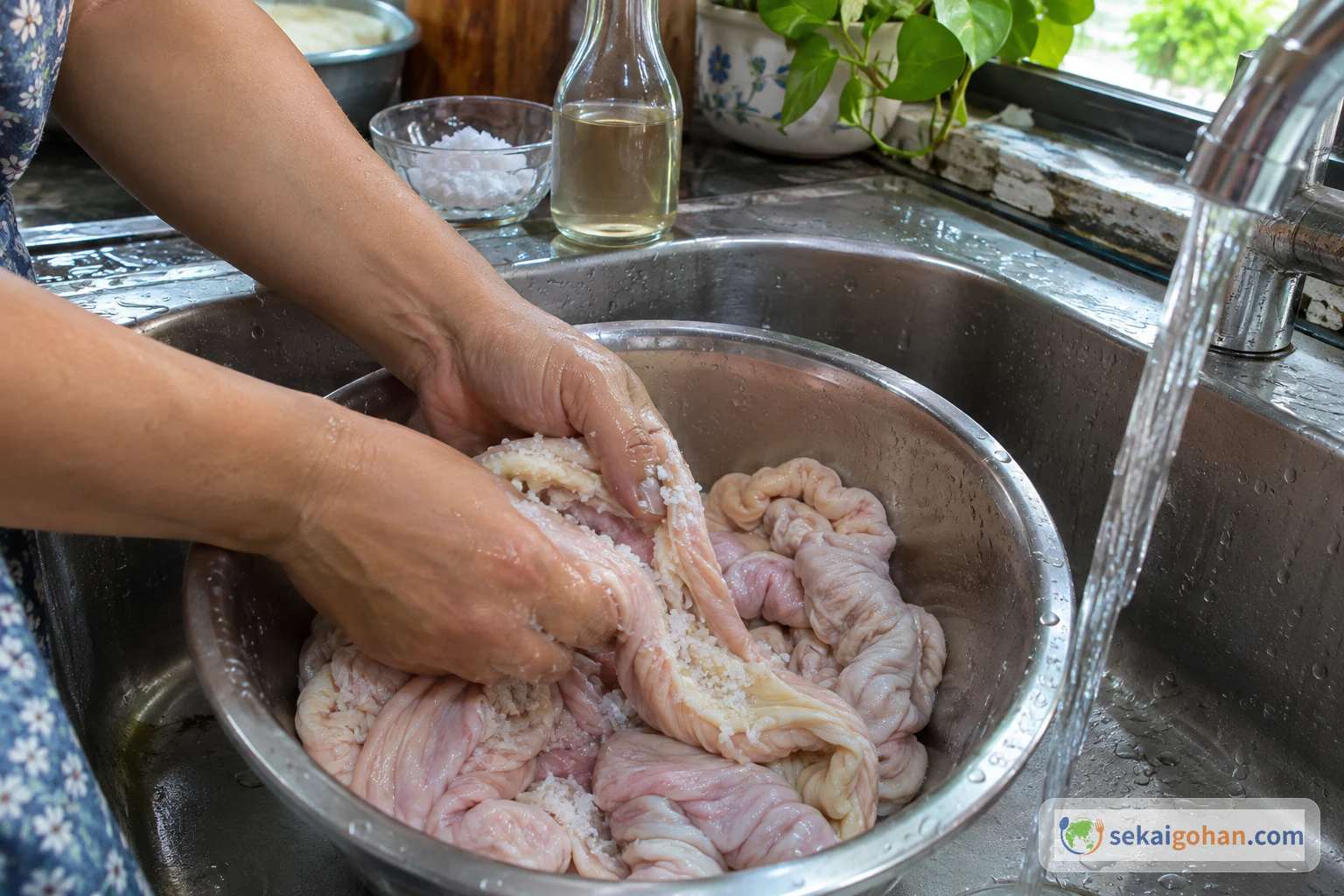
Pre-cleaned pork large intestine, fresh or frozen, saves the hardest part of the job. It still gets the salt-and-vinegar rub in step 1, which is what takes the barnyard edge off the finished bowl.
Soy sauce and yellow bean paste contain soy. Check both labels for wheat. The dish is built on pork offal.
Equipment
- Stockpot large enough to hold the intestine under water
- Heavy saucepan for the finished stew
- Small saucepan for the broth
- Small pan or wok for the garlic base
- Kitchen string
- Chopsticks
- Fine sieve
- Knife and cutting board
- Instant-read thermometer
Buying and Swapping
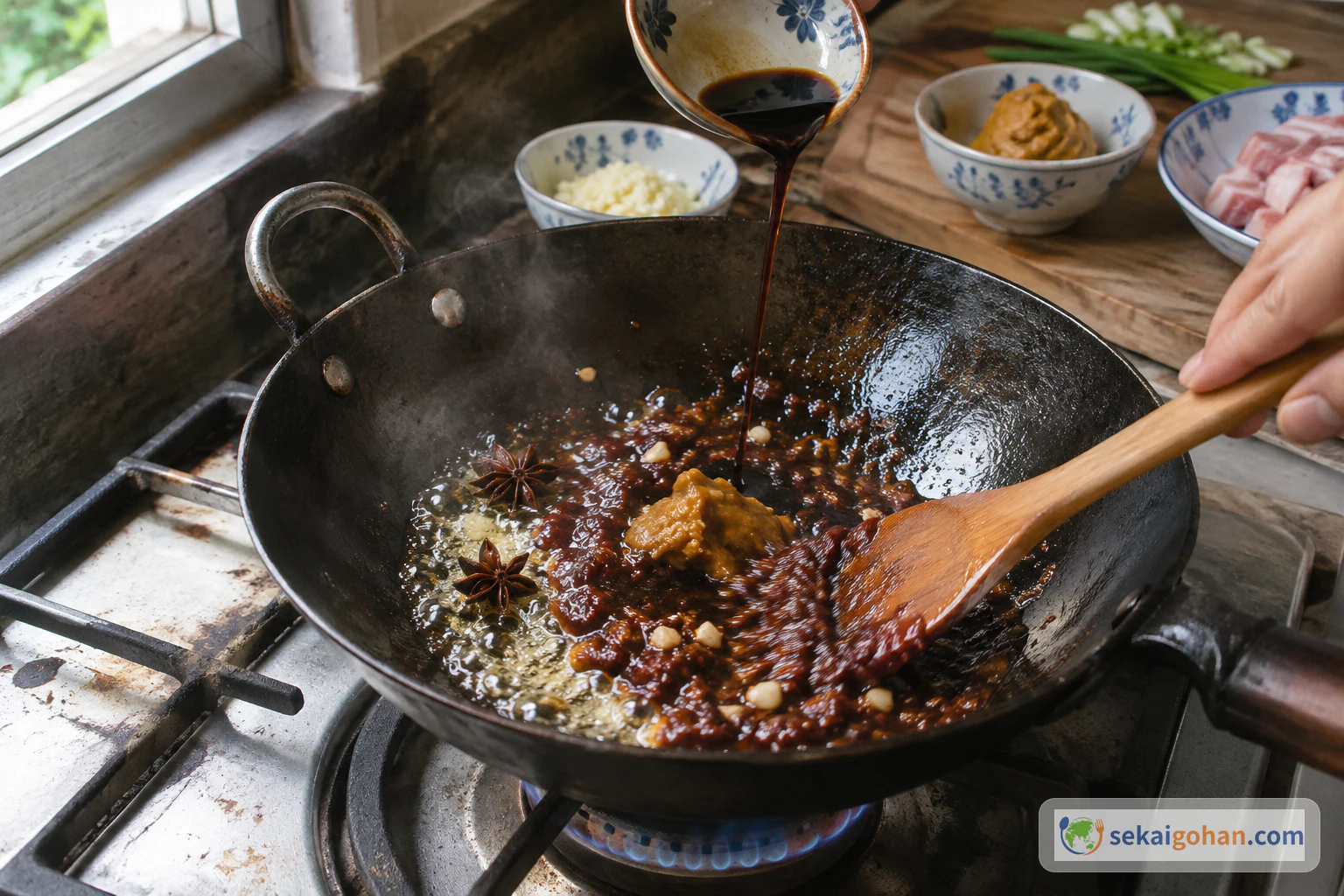
Yellow bean paste is a Chinese fermented soybean paste, sold in jars or pouches at Chinese grocers and online. Sweet bean sauce (tianmianjiang) and Japanese hatcho miso are different pastes with different sweetness and salt, so buy huangjiang itself. You only need a small amount, and it is what makes the base taste of Beijing.
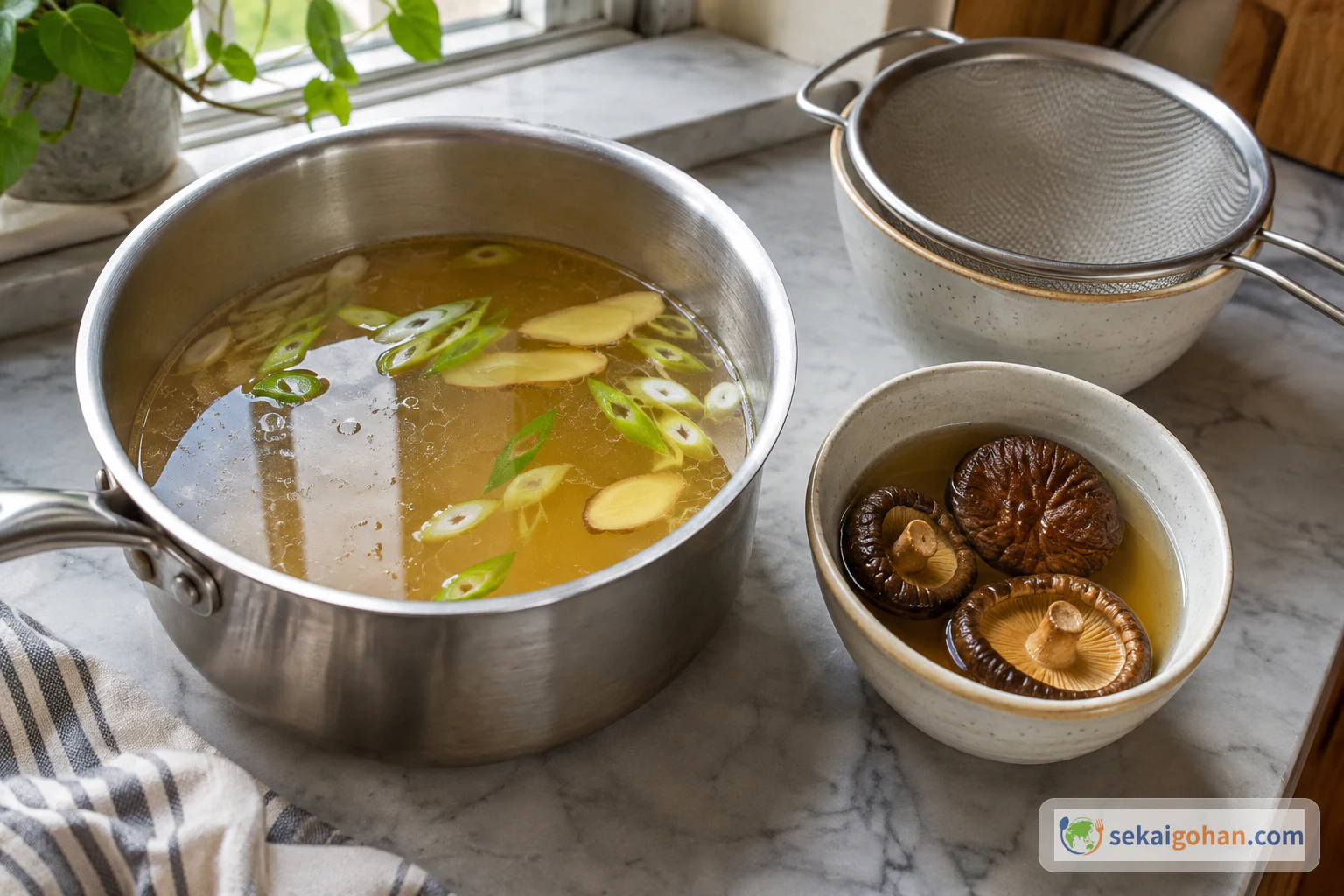
Koumo is the dried mushroom used for the broth, and it gives the broth its depth. Chinese grocers and online shops stock dried mushrooms. If you buy another dried mushroom, the broth will taste of that mushroom. Use a Chinese soy sauce. Chinese light and dark soy are separate products, and Japanese soy is another style again, so treat them as different seasonings rather than interchangeable bottles.
| Ingredient | Swap | What changes |
|---|---|---|
| Lard | Neutral vegetable oil | The garlic base loses some pork richness |
| Cornstarch | Potato starch | The same weight gives a different thickness. Pour the slurry gradually and stop at the right body |
| Koumo | Other dried mushrooms | The broth takes on the flavor of that mushroom |
| Fresh intestine | Pre-cleaned frozen intestine | Thaw it, then clean and cook it the same way |
Method
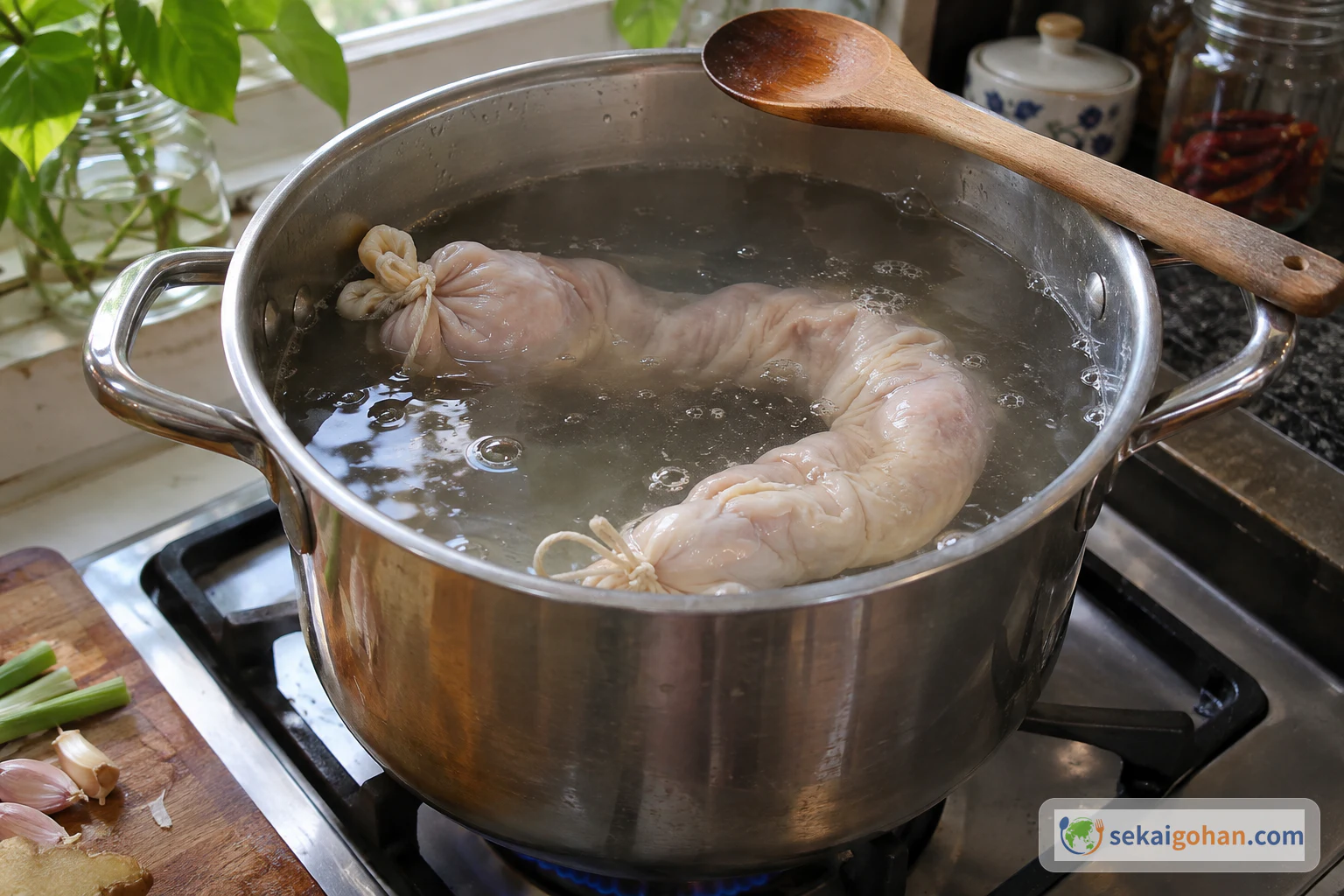
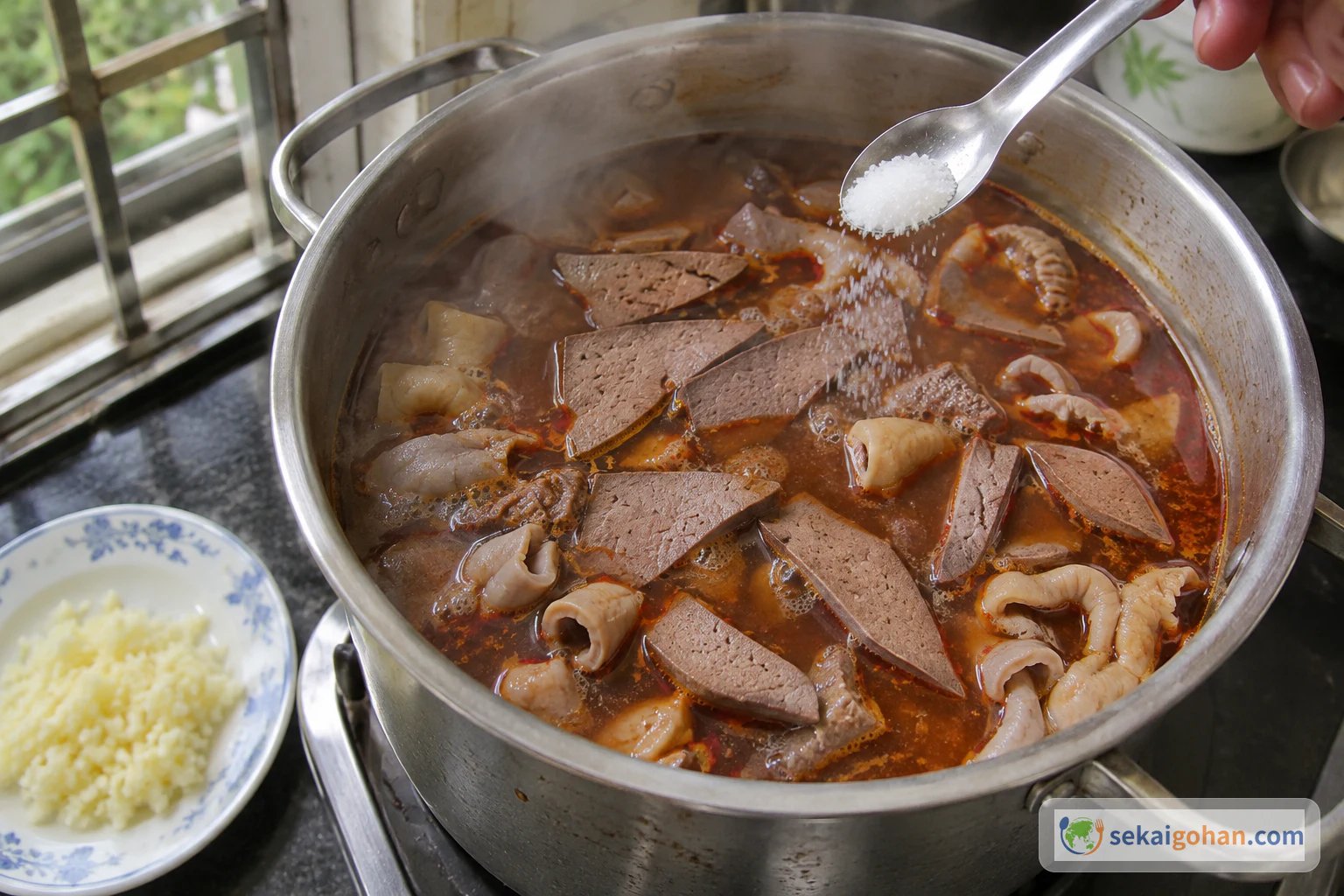
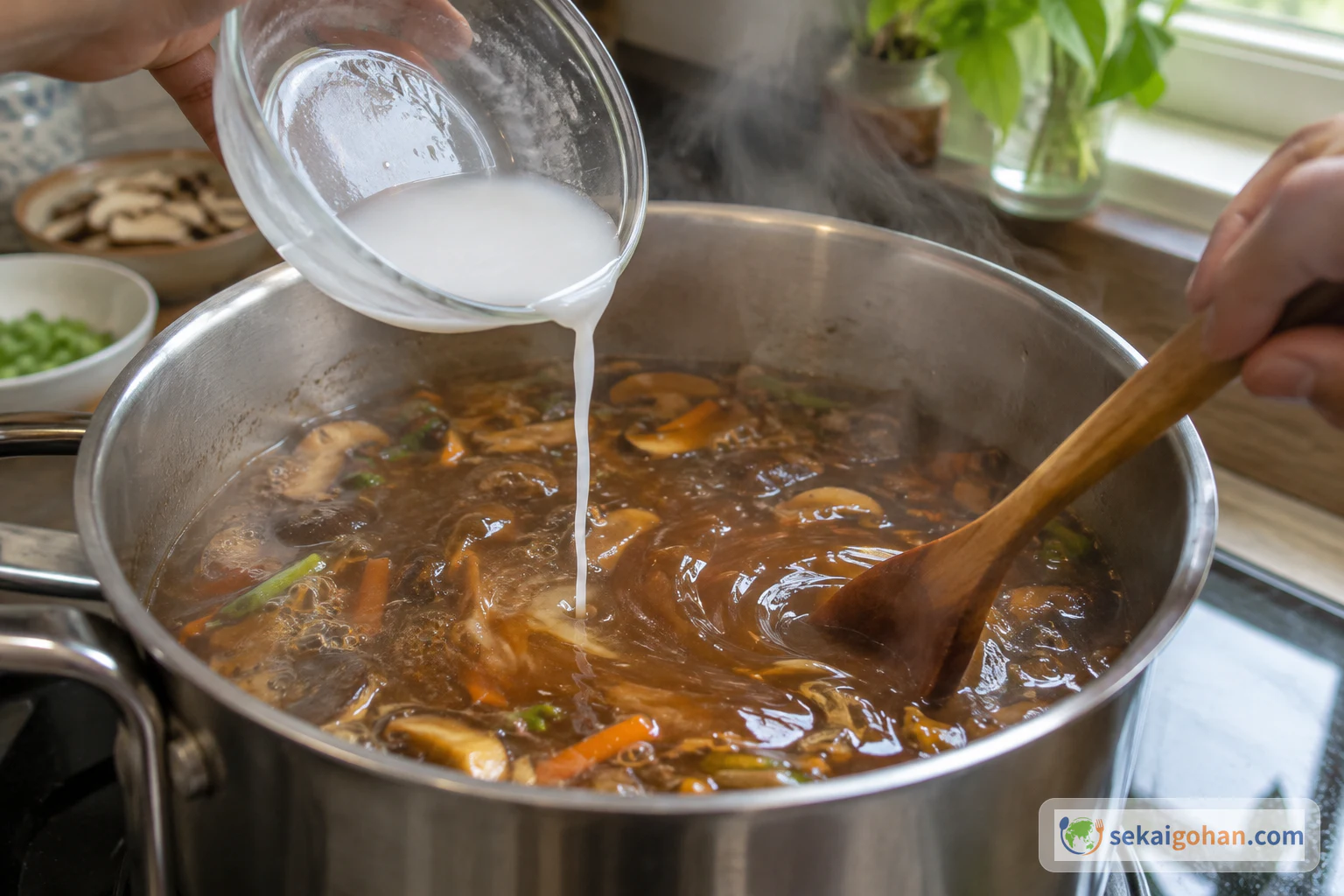
Start with the intestine, because it needs about two hours of quiet simmering. While it cooks, cut the liver, make the mushroom broth and fry the garlic base. The last three steps happen in one pot, close together, and they go fast once the broth is boiling.
Never eat pork meat or offal raw. Cook it until the center reaches 165°F (74°C). After the liver goes into the broth, check that the center of the pieces is cooked through. Make sure the intestine is thoroughly simmered before you cut it.
The garlic fried in lard gives a sweet, rounded base. The raw garlic added with the liver gives the sharp bite Beijing expects. Keep both halves. Using only one makes the bowl taste flat or harsh.
Starch sets properly only in boiling liquid. Pour slurry into a pot that is merely hot and you get a cloudy, thin broth that never firms up.
When It Goes Wrong
| What you see | Why | What to do |
|---|---|---|
| The bowl smells strongly of offal | The intestine was not cleaned enough, or not simmered long enough | Next time, rub the folds well with salt and vinegar and rinse thoroughly. Simmer until a chopstick slides through |
| The intestine is rubbery | It boiled hard instead of simmering | Keep the heat low so only small bubbles rise |
| The broth stays thin | The slurry went into a pot that was not boiling, or there was too little | Bring it back to a full boil and add more slurry gradually while stirring |
| There are lumps of starch | The slurry went in all at once without stirring | Stir the slurry smooth first, then pour in a thin stream while stirring |
| The liver is pink in the center | It has not cooked long enough | Keep the pot boiling until the center reaches 165°F (74°C) |
| The bowl turns watery as you eat | Stirring with a spoon breaks down the thickness | Sip from the rim and turn the bowl instead of stirring |
Serving and Variations
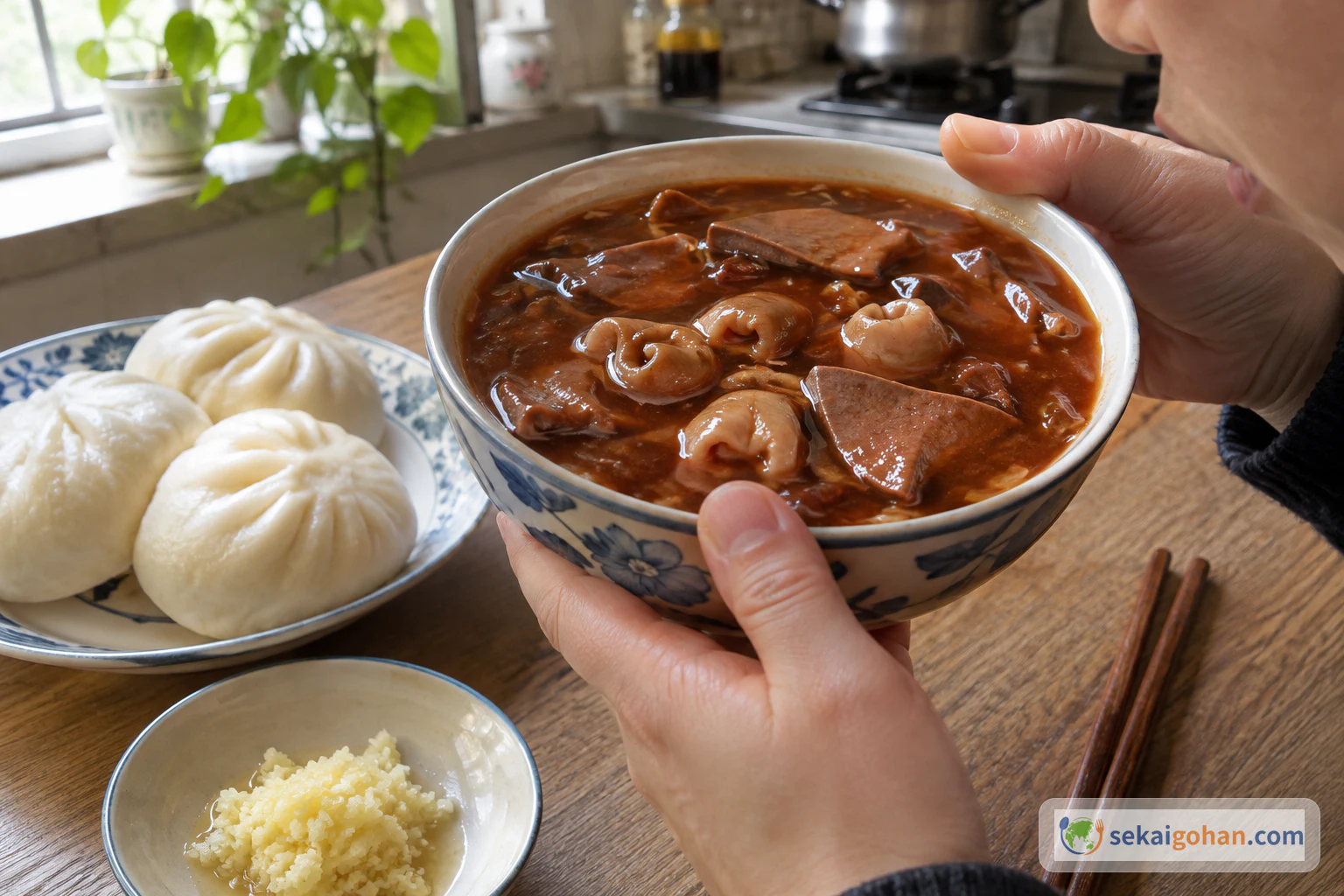
Serve chaogan hot, in small bowls, first thing in the morning. Small steamed buns are the old companion, and any filled steamed bun or fresh bread works well beside it. Set out chopsticks for the buns and nothing for the bowl, because everyone drinks from the rim.
Variations
- Unthickened: Leave out the starch and serve the stew as a thinner broth. You get a lighter bowl that you drink like soup, closer to the version linked with Huixianju.
- With small intestine: Replace part of the large intestine with small intestine, cleaned and simmered the same way. The bowl gets more pieces with a finer chew.
- MSG finish: Stir a pinch of MSG in with the raw garlic after thickening. It pushes the broth's savoriness further forward.
Frequently asked questions
Can I use frozen pre-cleaned intestine?
Yes. Thaw it fully, then give it the same salt-and-vinegar rub and rinse before you tie and simmer it. Simmer it until a chopstick slides through, just like fresh intestine.
How do I check the liver without a thermometer?
Cut open the thickest piece. The center should be cooked through, with the same color and firmness as the outside. A thermometer is the reliable check for 165°F (74°C) held for at least 1 minute, so use one if you have it.
Is chaogan the same as luzhu huoshao?
No. Both are Beijing pork intestine dishes, but they are separate stews. Chaogan is thickened with starch, pairs intestine with liver, carries a double hit of garlic and is sipped from the bowl without a spoon.
Where is it eaten in Beijing?
Huixianju and Tianxingju are well-known shops linked to chaogan.